
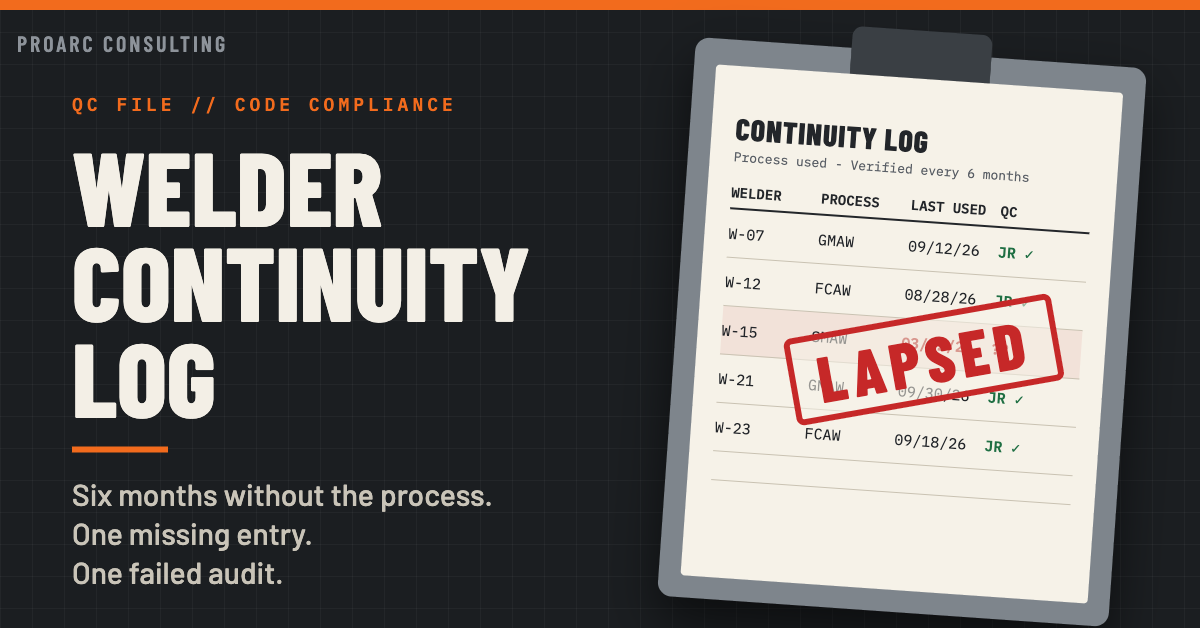
Every fab shop I walk into has a filing cabinet full of welder qualification records. Bend test results, WPQ forms, signatures, the works. Most shops are proud of that cabinet, and they should be. Getting a welder qualified costs real time and money.
But here’s what I see over and over. The test records are perfect, but the welder continuity log is missing, three months behind, or a sticky note on somebody’s monitor. That’s the document that tells an inspector whether those qualifications are still any good.
If you run a shop working to AWS D1.1, AWS D1.6, ASME Section IX, or any project with special inspection, a welder continuity log isn’t paperwork for the sake of paperwork. It’s what keeps your welders qualified to put metal on your jobs.
What Is A Welder Continuity Log?
A welder continuity log is a running record showing that each qualified welder has actually used each welding process they’re qualified for within a set period. It’s your proof that a qualification hasn’t quietly expired while nobody was looking.
A welder qualification is not a lifetime card. Under both AWS D1.1 and ASME Section IX (QW-322), a welder’s qualification for a process stays in effect only as long as they keep using that process. Go six months without running it and the qualification expires. The test record in your cabinet still exists, but it doesn’t mean anything anymore. The following is a clip out of AWS D1.1.
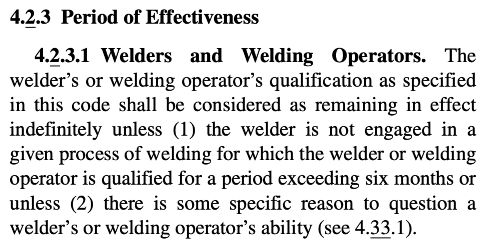
The continuity log is how you show that didn’t happen.
The Six-Month Rule Catches More Shops Than You’d Think
On paper, six months sounds like plenty of time. In a real shop, it goes fast. These are the situations I run into most:
- A welder gets moved to fitting, the saw, or the paint line during a slow stretch and doesn’t strike an arc for half a year.
- A guy is qualified for both GMAW and FCAW, but the shop has run nothing but solid wire for months. His FCAW qualification lapsed and nobody noticed.
- Someone comes back from a long layoff or leave and goes straight to production welding.
- A welder splits time between the shop and field work, and nobody’s tracking what he’s running out there.
In every one of those cases, the welder is just as skilled as the day he tested. That doesn’t matter. The code doesn’t care how good he is. It cares whether you can document that he kept his qualification current.
What Happens When an Inspector Asks for It
This is where it gets expensive.
As an AWS CWI and special inspector, one of the first things I verify on a structural steel job is that the welders doing the work are qualified for the process they’re using. A test record from two years ago doesn’t answer that question by itself. I need to see continuity.
If a shop can’t produce it, a few things can happen, and none of them are good:
- The welder gets pulled off the job until he requalifies.
- Welds he already made can be called into question. That can mean extra NDT, an engineering review, or in an even worse case, cutting out and redoing work.
- A nonconformance report gets written, and now it’s part of the project record.
- If you’re AISC certified, missing continuity records are an easy audit finding. Auditors look for this.
Requalifying one welder costs you a test plate, inspection fees, lab time, and his production hours. Requalifying a crew, or tearing out welds, can wipe out the margin on a job. Keeping a continuity log costs you about ten minutes a month.
What a Good Welder Continuity Log Should Include
It doesn’t need to be fancy. A spreadsheet works. A binder works. What matters is that it’s complete, current, and readable by somebody who isn’t you. At a minimum, each entry should show:
- Welder name and ID or stamp number
- Welding process (SMAW, GMAW, FCAW, GTAW, SAW)
- Date the process was last used
- Job or project number where the welding was done
- Initials or signature of the supervisor, QC person, or CWI verifying it
- Reference to the original qualification record so an inspector can tie the two together
Keep one line per welder per process. If a welder is qualified for three processes, he needs three lines kept current, not one.
How to Keep Welder Continuity From Slipping
The shops that never have trouble with this all do roughly the same things.
Pick one person who owns it. QC manager, shop foreman, office manager, it doesn’t matter who. If it’s everybody’s job, it’s nobody’s job.
Update it on a schedule. Monthly is good. Tie it to something you already do, like payroll or job close-out, so it doesn’t get forgotten.
Flag anybody approaching five months. Don’t wait for six. If a welder hasn’t run a process in five months, get him on a production weld with it, or line up a retest before he lapses.
Keep it where it can be found. If the only copy is on one guy’s laptop and he’s on vacation when the inspector shows up, you don’t have a continuity log.
Check it before every job. When you assign welders to a project, look at the log first. It’s a lot easier to fix a gap before the job starts than after an inspector finds it.
The Bottom Line
Your qualification records prove your welders passed a test. Your welder continuity log proves they’re still qualified today. Inspectors, auditors, and engineers of record need both. A shop that can hand over a clean, current log on request looks like a shop that knows what it’s doing, because it does.
If your continuity records are behind, or you’re not sure whether some of your welders have already lapsed, find out now instead of on the job site.
ProArc Consulting helps fabrication shops set up welder qualification and continuity programs, qualify and requalify welders, and get ready for inspections and audits. We’re based in Plainfield, Illinois, and work with shops across the nation. Contact us to get your welder records squared away.

Leave a Reply